

In an era increasingly characterized by technological independence and innovation, Ola’s initiative to create and implement its own mapping solution, Ola Maps, marks a pivotal development. This strategic move, projected to save the company approximately ₹100 crores annually by moving away from Azure and Google Maps, underscores a significant trend in India’s technology sector: the drive towards self-sufficiency and the development of solutions tailored to local requirements.
Strategic Advantages Beyond Cost Savings
At first glance, the financial benefits of transitioning from Google Maps to Ola Maps are apparent. However, the true value of this shift lies in the strategic advantages it offers. By developing its own mapping solution, Ola gains complete control over the data generated by its users. This data sovereignty allows the company to refine its services, make more informed decisions, and offer a highly personalized user experience.
Moreover, Ola Maps is designed with a deep understanding of the Indian context. Unlike Google Maps, which serves a global audience, Ola Maps addresses the specific challenges faced by Indian consumers. These include navigating narrow roads, identifying local landmarks, and adapting to dynamic traffic conditions—factors that can significantly enhance the user experience. By focusing on these aspects, Ola is not just offering a mapping solution; it is providing a service that resonates with the everyday realities of Indian life.
Enhancing the Customer Experience
Ola Maps stands out in a crowded field by offering features that are uniquely relevant to Indian users. The integration of regional landmarks and cultural points of interest into the mapping platform ensures that users can navigate with a richer understanding of their surroundings. This feature is particularly valuable in a country as diverse as India, where local knowledge can greatly improve navigation accuracy.
Furthermore, Ola Maps automatically localizes into various Indic languages, broadening accessibility for a larger segment of the population. In a multilingual environment, this feature is vital for overcoming language barriers that often hinder technology adoption.
Ola Maps also addresses specific challenges often overlooked by global mapping solutions. Its design caters to the distinct needs of Indian cities, where narrow roads and unpredictable traffic patterns are commonplace, ensuring a more reliable navigation experience.
The Role of Krutrim AI Cloud
Ola’s AI Cloud, Krutrim, is at the heart of the development and operation of Ola Maps. Krutrim’s advanced AI capabilities are utilized for data analysis, predictive modeling, and creating personalized user experiences. Street imagery captured by Ola’s data operations fleet is processed by Krutrim’s AI models, extracting crucial geo-data such as Points of Interest (POIs), traffic signs, and turns. This continuous data processing ensures that Ola Maps remains accurate and responsive, adapting to the evolving needs of its users.
Implications for Partnerships and Competition
Ola’s transition to a proprietary mapping system extends beyond a mere technical adjustment; it has significant implications for its partnerships and competitive positioning within the transportation and technology sectors. By developing its own solution, Ola diminishes its reliance on external technology providers, potentially fostering more advantageous collaborations within the Indian tech ecosystem. However, this shift also presents challenges, particularly regarding regulatory compliance and the continuous need for innovation to remain competitive.
This commitment to creating an indigenous mapping solution aligns with the Indian government’s vision of Atmanirbhar Bharat (Self-Reliant India), promoting the development of homegrown solutions that address local needs. Ola Maps is not just a product; it exemplifies the potential of Indian innovation to tackle uniquely Indian challenges.
Challenges in Implementation
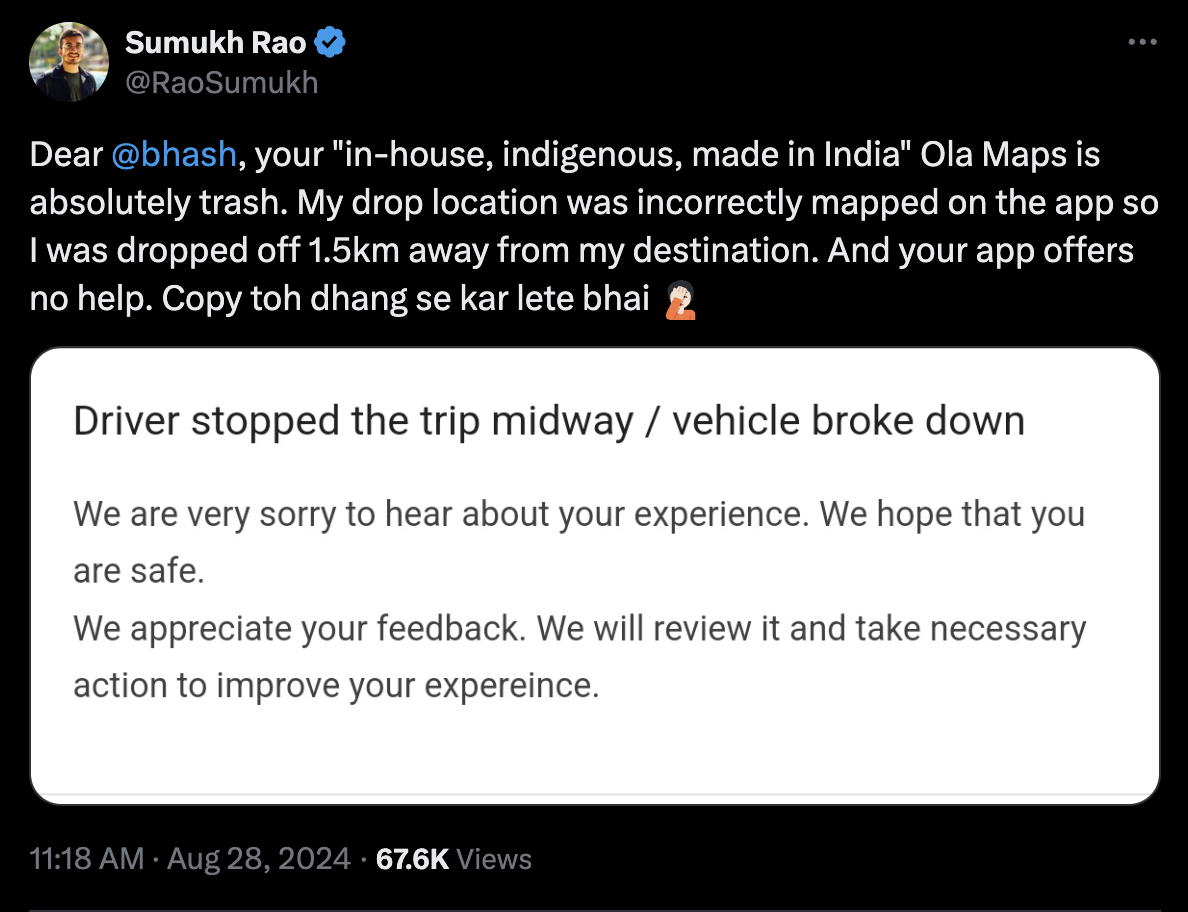
While the strategic advantages of Ola Maps are clear, the implementation has not been without challenges, particularly for developers. The Java SDK used for Ola Maps has been reported to have inaccuracies in instructions and debugging difficulties. The closed-source nature of the SDK and its reliance on the Kotlin library have also posed limitations. These issues highlight the ongoing need for improvement and refinement in the tools provided to developers, ensuring that Ola Maps can achieve its full potential.
Competitive Landscape and Google’s Response
Ola’s entry into the mapping market has not gone unnoticed by its competitors. In response to Ola Maps, Google has significantly reduced the pricing of its Maps platform for developers in India by up to 70%. This move indicates the competitive pressure that indigenous solutions like Ola Maps are exerting on established global players. Google has also introduced new features, such as reducing the use of narrow roads for four-wheelers, calling out flyovers along recommended routes, and providing information about EV charging stations, all in an effort to retain its market share.
However, Ola Maps must address several critical issues to attract developers effectively. As a developer, I find that while I could utilize numerous Google Map APIs, Ola Maps lacks comprehensive documentation to help facilitate a smooth transition. There is currently no comparison chart published by Ola Maps that outlines its offerings versus Google Maps, which would be beneficial for developers considering a switch. If Ola wants to encourage developers to migrate to its platform, it should include this information as part of its documentation, as the existing resources do not provide adequate guidance on these aspects. Addressing these gaps promptly will be essential for Ola Maps to capitalize on the competitive landscape and gain traction among developers.
Addressing Allegations of Infringement
Recently, MapmyIndia, a prominent player in the Indian mapping space, raised concerns about Ola’s entry into the market with Ola Maps. These concerns included allegations that Ola’s mapping solution might undermine the established market dynamics and potentially infringe on areas where MapmyIndia has long been a dominant player. While such allegations are a normal part of competitive dynamics, they also underscore the importance of maintaining transparency and professionalism.
Ola has addressed these concerns with a clear and measured response, emphasizing its commitment to innovation and its focus on serving the unique needs of Indian consumers. The company has justified its entry into the mapping space by highlighting the gaps in existing solutions and its belief that competition drives progress and enhances the overall quality of services available to users. Ola asserts that its primary goal is to deliver a mapping solution that is deeply attuned to the Indian context, one that is built from the ground up to tackle the specific challenges of navigating India’s diverse and complex terrain.
Ola’s entry into the mapping space is viewed as a move to foster a culture of continuous improvement and adaptation, which is essential for keeping pace with the rapidly changing demands of the market.
Conclusion
It’s important to note that there is no free trial available for Krutrim AI to evaluate the platform, which presents a challenge for potential users who need to incur costs upfront just to assess its capabilities. Additionally, the shortage of GPU machines has raised concerns; nearly all are sold out, making it difficult for developers to explore the cloud features effectively. This situation is unusual compared to other cloud services like AWS and GCP, where such shortages are rarely seen.
Despite these challenges, Ola is actively enhancing its platform with new features, including AI Pods and Language Labs, which are being rolled out incrementally. Many of these features are still in beta, but initial experiences with tools like Sentiment Analysis and Text Summarization in Language Labs have been promising, with quick and accurate responses.
This development reflects a significant shift in the Indian tech landscape—one where local solutions are increasingly being developed to meet indigenous needs, reducing reliance on global technology providers and fostering a more self-sufficient tech ecosystem. As Ola continues to enhance and expand its mapping capabilities, it is well-positioned to influence the future of Indian technology, showcasing the power of innovation rooted in local context and a profound understanding of the market it serves.
 Josh Software