

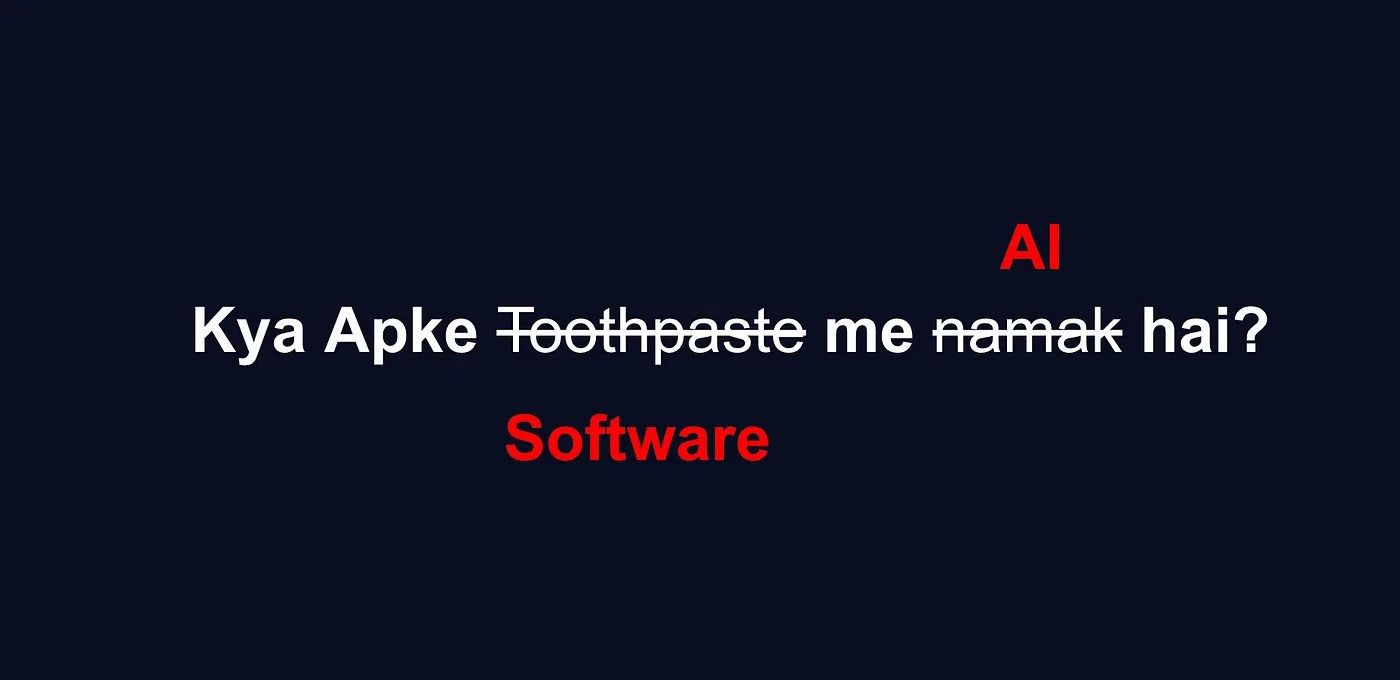
Remember the iconic toothpaste ad: “Kya aapke toothpaste mein namak hai?” It made everyone wonder why on earth we needed salt in toothpaste.
Fast forward to today, and we’re living in a similar moment in tech: “Kya aapke software mein AI hai?” If the answer is no, prepare for judgmental stares, awkward silences, and unsolicited advice about how “AI will revolutionize your life.”
But, let’s take a step back and ask: Do we really need AI in every software? Spoiler alert: Nope.
AI Then vs. AI Now 🚀🤖
A few years ago, AI was the stuff of sci-fi movies. We imagined sentient robots plotting world domination, uploading our consciousness to the cloud, and flawless virtual assistants. Fast forward to 2024, and our actual experience with AI looks something like this:
- Expectation: Jarvis from Iron Man
- Reality: “Sorry, I didn’t catch that. Did you mean ‘Play Despacito’?”
While movies like Ex Machina made us dream of super-intelligent machines, today’s AI feels more like a less dumb version of a human — good for certain tasks but still capable of making hilariously dumb mistakes.
Here’s a visual representation of how AI was sold to us vs. how it actually is:
(Expectation: A robot takeover. Reality: A robot that can’t decide if a blueberry muffin is a chihuahua.)

Can you tell the difference? Photo courtesy @teenybiscuit
ChatGPT vs. Llama: A Tale of Two Bottles 🍼💡
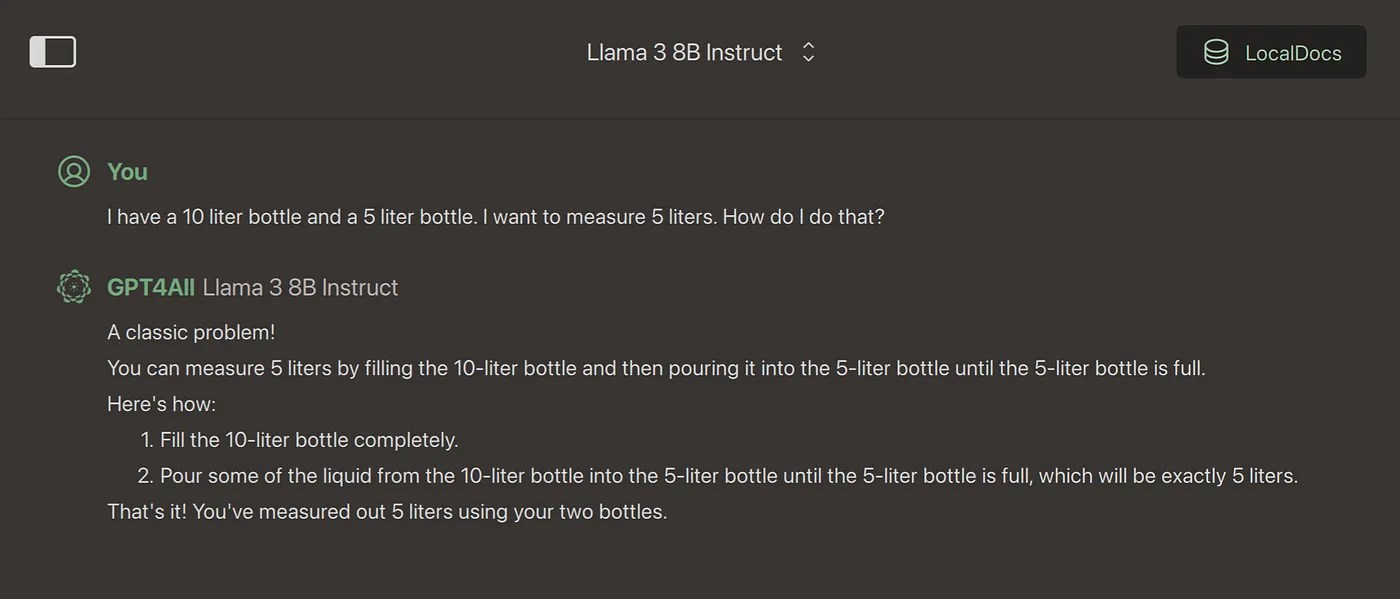
Let me share an example from a recent tête-à-tête with two well-known AI models. The task? Solve a classic brain teaser: How to measure exactly 5 liters using a 10-liter and a 5-liter bottle?
Llama’s Response:
“Just pour water from the big bottle into the small one until the small one is full. Boom. Done.”
Here’s the screenshot proof:
ChatGPT’s Response:
“Oh, you want 5 liters? Let me give you a step-by-step tutorial complete with extra flair and a mini-celebration at the end.”

Takeaway? Llama’s like that one friend who gives you the TL;DR, while ChatGPT treats every problem like it’s hosting a TED Talk. Both answers are valid, but neither feels revolutionary.
Unnecessary AI Add-ons: The Toothpaste Effect 🧂
Just like toothpaste didn’t really need salt, not every app or software needs AI. Adding it just for the sake of it often leads to:
- Over-engineering: A simple app that calculates your grocery bill now takes 5 minutes to load because it’s using AI to “predict” what you might buy next.
- Unintended Consequences: Like an AI model that confidently tells you a mushroom is safe to eat (spoiler: it’s not).
- Pointless Features: Remember the “AI-powered” fridge that recommends recipes? Who’s cooking quinoa at 2 AM?
The Golden Rule: Where AI Actually Shines 🌟
Now, don’t get me wrong — AI can be magical in the right context. Here’s where it truly shines:
- Repetitive Tasks: Automating things like sorting emails or tagging photos.
- Data Insights: Finding patterns in massive datasets that would take humans years to analyze.
- Complex Problem Solving: Applications like drug discovery, personalized healthcare, or self-driving cars.
But here’s the trick: AI is a tool, not a solution. A good developer knows when it’s genuinely useful and when it’s just a shiny distraction.
The Conclusion: Teaching AI What Not to Do 🎓🤦
The reality of today’s AI isn’t about intelligence — it’s about making AI less dumb. It’s about teaching these models what to do, but more importantly, what not to do.
So, the next time someone asks, “Kya aapke software mein AI hai?”, ask them back:
- Does it need AI?
- Will AI make it better?
- Or are we just adding AI because it’s trending?
Because if your software doesn’t actually need AI, all you’re doing is overcomplicating your app — salt in toothpaste-style.
And remember, sometimes, the smartest choice is the simplest one. Or as AI might put it: “Just pour water into the smaller bottle until it’s full.” 😉
Share Your Thoughts!
What’s the funniest or most unnecessary use of AI you’ve come across? Let me know in the comments below. Bonus points if it involves a “smart” appliance that made you feel dumber.
 Josh Software