

The HTTP protocol is one of the most important technologies behind the internet. Every time you open a website, watch a video online, use a mobile application, or interact with a REST API, HTTP is working behind the scenes. It acts as the communication bridge between clients, such as web browsers or mobile apps, and servers that provide data and services.
Although HTTP has been around for many years, it continues to evolve to meet the changing needs of modern applications. As web applications become more complex, developers need better ways to communicate with servers while keeping APIs clean, efficient, and easy to understand.
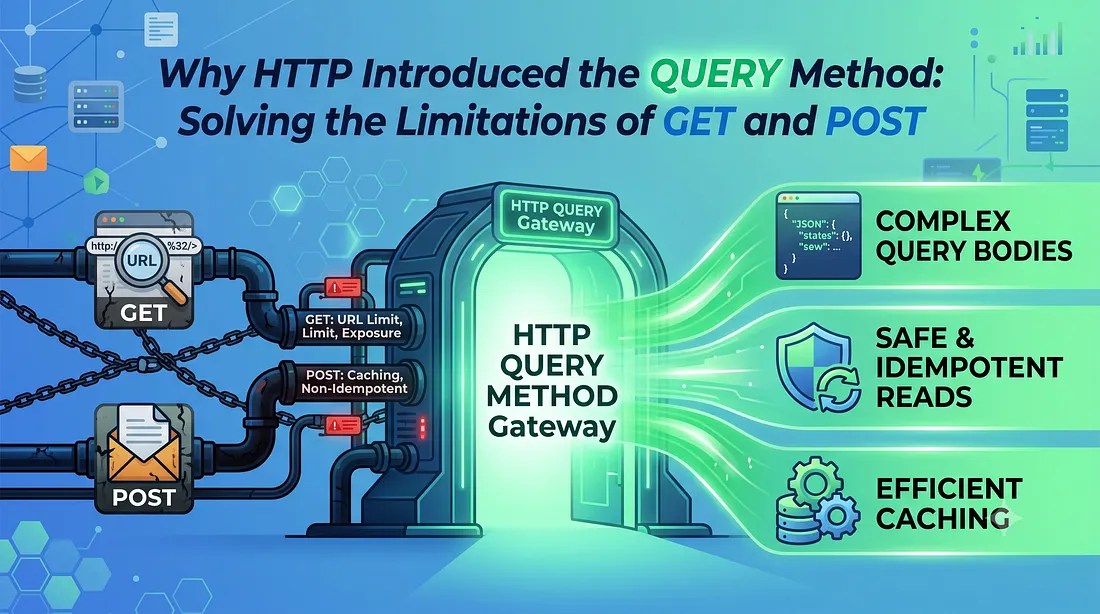
One of the biggest recent improvements is the introduction of the HTTP QUERY method, standardized in RFC 10008. This new HTTP method is designed specifically for performing complex search and query operations. For years, developers mainly relied on GET and POST requests for searching data, but both approaches had their own limitations. The QUERY method fills this gap by providing a cleaner, more meaningful, and standardized solution.
In this blog, we’ll understand why the QUERY method was introduced, what problem it solves, how it works, its advantages, and why it could become an important part of future API development.
The Problem with GET Requests
Whenever we want to retrieve data from a server, the first HTTP method that comes to mind is GET.
For example:
GET /products
This works perfectly when we simply want to retrieve all products from a database.
However, real-world applications are rarely this simple.
Most applications allow users to search and filter data based on different conditions. For example, an e-commerce website may allow users to filter products by:
- Brand
- Price Range
- Rating
- Category
- Color
- Date Range
- Pagination
- Sorting
- Availability
- Storage Capacity
A typical request may look like this:
GET /products?category=laptop&brand=dell&price=1000&rating=4&sort=price&page=5&color=black&storage=512GB
Initially, this seems acceptable. But as more filters are added, the URL becomes longer and more difficult to understand.
Large enterprise applications often have dozens of filters, making URLs extremely lengthy and difficult to manage.
Problems with very long URLs include:
- Difficult to read and understand
- Harder to maintain during development
- More difficult to debug
- Practical URL length limitations in browsers
- Restrictions imposed by proxies and API gateways
- Some servers reject extremely long URLs
- Requests may fail with an error such as:
414 URI Too Long
Although the HTTP specification itself does not define a maximum URL length, many browsers, web servers, and proxies impose practical limits. This has been a common challenge for API developers for many years.
Why Not Use POST Instead?
To overcome the limitations of long URLs, many developers started using the POST method for search operations.
For example:
POST /products/search
Request Body:
{ "category": "laptop", "brand": "Dell", "price": 1000, "rating": 4, "sort": "price", "page": 5}
Using POST allows developers to place all search filters inside the request body instead of the URL. JSON is much easier to organize and can represent nested objects, arrays, and complex filtering conditions.
Although this approach works very well in practice, it introduces another issue.
POST was primarily designed for operations that create or process resources on the server.
Searching for products does not create anything.
Searching does not update anything.
Searching does not delete anything.
It is simply a request to retrieve information.
This means developers were using POST for an operation that is fundamentally read-only. While this has become a common industry practice, it does not clearly express the actual purpose of the request.
The Semantic Problem
HTTP methods are designed with specific meanings.
- GET : Retrieve data
- POST : Create or process data
- PUT : Replace existing data
- PATCH : Partially update data
- DELETE : Delete data
Searching is actually a read-only operation.
Nothing changes on the server.
No new resource is created.
No existing resource is updated.
No database record is deleted.
Yet developers often had no better option than using POST because GET requests became impractical for complex searches.
This created a semantic mismatch between the HTTP method and the actual operation being performed.
The introduction of QUERY solves this long-standing problem by providing a method specifically designed for read-only queries.
Introducing the HTTP QUERY Method
To solve this problem, a new HTTP method called QUERY has been introduced.
Its purpose is simple:
Perform complex read-only queries without changing server data.
Instead of sending dozens or even hundreds of query parameters in the URL, developers can send the search criteria inside the request body while still making it clear that the request is only retrieving data.
For example:
QUERY /products
Request Body:
{ "category": "Laptop", "brand": "Dell", "price": { "max": 1000 }, "rating": 4, "sort": "price", "page": 5 }
This approach is much cleaner than building an extremely long URL and better represents the true intention of the client.
According to RFC 10008, QUERY is defined as a safe and idempotent HTTP method, meaning that executing the same request multiple times does not change the server’s state.
Advantages of QUERY
- Cleaner URLs :
Instead of placing every filter in the URL, all search conditions are stored inside the request body.
Your endpoint remains simple and easy to understand.
QUERY /products
A cleaner endpoint also makes API documentation easier to maintain.
2. Better Readability :
JSON request bodies are much easier to read than long URLs.
Compare these two approaches.
Long URL:
GET /products?brand=dell&price=1000&rating=4&page=2&sort=price
JSON:
{ "brand": "Dell", "price": 1000, "rating": 4, "page": 2, "sort": "price"}
The JSON version is easier for developers to understand, modify, and debug.
3. Better Support for Complex Searches :
Modern applications support much more than simple filtering.
For example:
- Multiple categories
- Nested filters
- Date ranges
- Multiple sorting rules
- Logical AND/OR conditions
- Pagination
- Full-text search
- Location-based filtering
Representing these conditions using URL parameters quickly becomes complicated.
JSON naturally handles these complex structures without making requests difficult to understand.
4 . Correct HTTP Semantics :
One of the biggest advantages of QUERY is that it correctly communicates the purpose of the request.
When another developer sees a QUERY request, they immediately know:
- The request retrieves data.
- It does not create resources.
- It does not update data.
- It does not delete data.
This makes APIs easier to understand and follows REST principles more closely.
5. Better API Design :
Many APIs currently expose custom search endpoints like:
POST /products/searchPOST /users/filterPOST /orders/query
With the QUERY method, developers can simply write:
QUERY /productsQUERY /usersQUERY /orders
This creates a more consistent, standardized, and self-explanatory API design.
Does QUERY Replace GET?
No.
GET is still the best choice for simple requests.
For example:
GET /usersGET /products/123GET /categories
These requests are straightforward and do not require a request body.
QUERY is intended for situations where search criteria become too complex to fit comfortably inside a URL.
A simple way to remember the difference is:
- GET → Simple retrieval
- QUERY → Complex retrieval
Both methods solve different problems and will continue to exist together.
Real-World Example :
Imagine you’re building an e-commerce website.
A customer wants:
- Dell laptops
- Price below ₹80,000
- Rating above 4 stars
- SSD storage
- Windows operating system
- Available in black
- Delivery within 2 days
- Sort by lowest price
- Page 3
Representing all these filters in a GET URL would create a very long and difficult-to-read request.
Using QUERY, all these search conditions can be placed inside a structured JSON request body, making the request much cleaner, easier to maintain, and easier for other developers to understand.
Will Developers Start Using QUERY Immediately?
Probably not.
Although the QUERY method has now been standardized, widespread adoption will take time.
Programming frameworks, browsers, reverse proxies, API gateways, cloud providers, and developer tools all need to add support for this new HTTP method.
Existing applications that already use GET and POST are unlikely to change overnight.
However, as support gradually improves, QUERY could become the preferred solution for complex read-only search operations because it better represents the intent of the request and promotes cleaner API design.
Conclusion :
The introduction of the HTTP QUERY method is one of the most significant improvements to HTTP in recent years. For a long time, developers had to choose between using very long GET URLs or using POST for operations that only retrieved data. While both approaches worked, neither was an ideal solution.
The QUERY method fills this gap by allowing clients to send complex search criteria inside the request body while clearly indicating that the operation is safe, read-only, and does not modify server data. It keeps URLs clean, improves readability, supports advanced filtering, and better aligns with the intended meaning of HTTP methods.
Although it will take time for the entire web ecosystem to adopt QUERY, it represents an important step toward more expressive and standardized API design. For developers learning backend development, REST APIs, or preparing for technical interviews, understanding the purpose of the QUERY method and the problem it solves is valuable knowledge that reflects the ongoing evolution of modern web technologies.

