

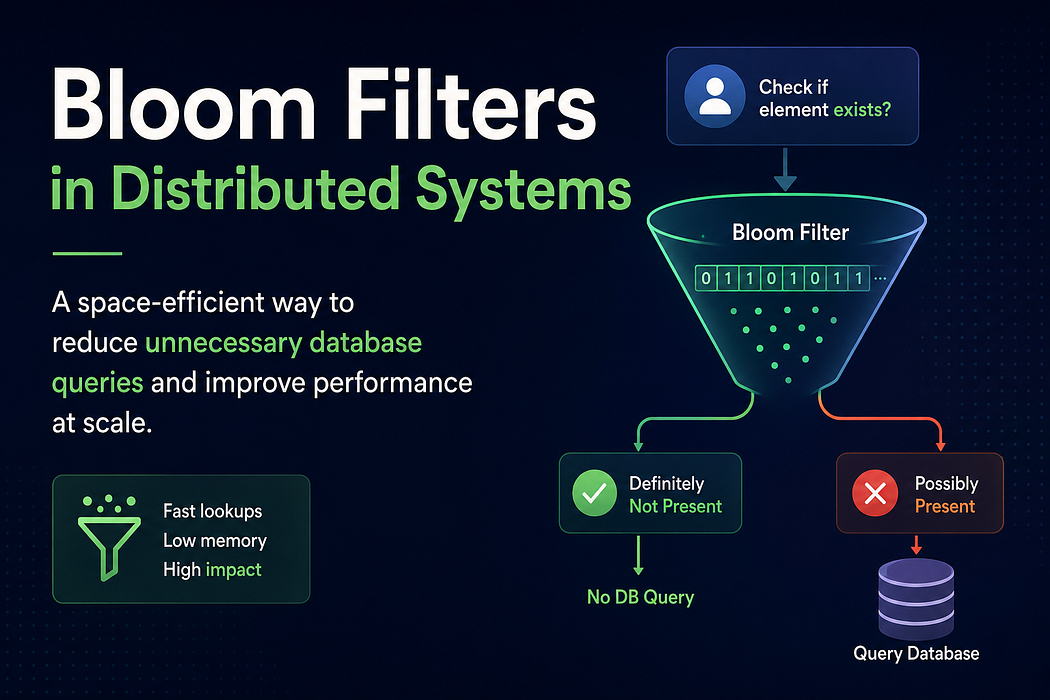
How a simple probabilistic data structure can reduce database load, improve response time, and help backend systems scale efficiently.
Introduction
As backend engineers, we often spend considerable time optimizing SQL queries, adding indexes, introducing caching layers, and scaling databases. While these optimizations are essential, there is another question worth asking:
Can we avoid the database query altogether?
In many applications, a significant percentage of database queries are performed only to discover that the requested data does not exist. Whether it’s checking if a username is available, validating an order ID, verifying a coupon code, or looking up a product, these negative lookups still consume database resources.
At a small scale, this isn’t a major concern. However, in systems processing thousands or even millions of requests per minute, these unnecessary queries can become a serious performance bottleneck.
This is where Bloom Filters provide an elegant solution.
Instead of optimizing the database query, Bloom filters help eliminate many of those queries before they ever reach the database.
In this article, we’ll understand what Bloom filters are, how they work internally, why they’re so efficient, where they are used in production systems, and how to implement one in Java using Google’s Guava library.
The Problem with Traditional Lookups
Consider a typical user registration system.
Whenever a user enters a username, the backend checks whether it already exists.
SELECT COUNT(*)FROM usersWHERE username = 'john_doe';
This query is simple, indexed, and fast.
Now imagine your platform has:
- 20 million registered users
- 200,000 username availability requests every minute
- Thousands of concurrent signup attempts
Even with proper indexing, every request still reaches the database.
The database spends valuable resources answering the same question repeatedly:
“Does this value exist?”
The problem becomes even more apparent because a large percentage of those usernames may not exist at all. Yet every request still performs a database lookup.
Instead of making the database answer every request, what if we could quickly identify requests that are guaranteed not to exist?
That’s exactly what Bloom filters are designed to do.
What Is a Bloom Filter?
A Bloom filter is a probabilistic data structure used to test whether an element is a member of a set.
Unlike a HashSet, a Bloom filter does not store the actual values.
Instead, it stores a compact representation using:
- A bit array
- Multiple hash functions
Its behavior is defined by two guarantees:
- If a Bloom filter says an element does not exist, it is guaranteed not to exist.
- If it says an element exists, it might exist.
The second case introduces the possibility of a false positive, which is an intentional trade-off for achieving extremely low memory usage and very fast lookups.
One important property is that Bloom filters never produce false negatives.
This means if the filter says an element is absent, you can trust that answer comIntroductionpletely.
How Does a Bloom Filter Work?
Let’s understand the internal working without diving too deep into mathematical details.
Initially, a Bloom filter contains a bit array where every position is set to 0.
0 0 0 0 0 0 0 0 0 0 0 0
Inserting an Element
Suppose we insert the username:
kunal
The username is passed through multiple hash functions.
For example:
- Hash Function 1 → Index 2
- Hash Function 2 → Index 7
- Hash Function 3 → Index 10
The corresponding bits are changed from 0 to 1.
0 0 1 0 0 0 0 1 0 0 1 0
The username itself is never stored.
Only these bits are updated.
Looking Up an Element
Now suppose another request arrives for:
alex
The same hash functions generate three indexes.
If any one of those bits is 0, we immediately know:
The element definitely does not exist.
No database query is necessary.
However, if all those bits are already 1, the Bloom filter responds:
“This element might exist.”
At that point, we perform the database lookup to verify.
Why Is This So Powerful?
Bloom filters are incredibly effective because they eliminate a large number of unnecessary database queries.
Instead of asking the database every time, we only ask it when the Bloom filter indicates there is a possibility that the data exists.
This simple optimization offers several benefits:
- Constant-time lookups
- Extremely small memory footprint
- Reduced database load
- Lower latency
- Better scalability under heavy traffic
Rather than making your database faster, Bloom filters reduce how often your application needs to use it.
Sometimes the best optimization is avoiding the work altogether.
A Practical Example: Username Availability
Let’s revisit our username availability example.
Without a Bloom filter, every request follows this path:
Client │ ▼Application │ ▼Database
Even usernames that have never existed still trigger a database query.
With a Bloom filter, the flow changes:
Client │ ▼Application │ ▼Bloom Filter │ ├── Definitely Not Present │ │ │ └── Username is available │ └── Possibly Present │ ▼ Database
If the Bloom filter reports that the username is definitely absent, the application can immediately tell the user that the username is available.
Only when the filter reports possibly present does the application consult the database.
This dramatically reduces unnecessary database traffic.
Java Implementation Using Guava
Google’s Guava library provides a simple and efficient Bloom filter implementation.
Creating one requires only a few lines of code.
import com.google.common.hash.BloomFilter;import com.google.common.hash.Funnels;import java.nio.charset.StandardCharsets;BloomFilter<CharSequence> bloomFilter = BloomFilter.create( Funnels.stringFunnel(StandardCharsets.UTF_8), 1_000_000, 0.01 );bloomFilter.put("john_doe");System.out.println(bloomFilter.mightContain("john_doe"));System.out.println(bloomFilter.mightContain("alice"));
The constructor accepts three important parameters:
- Funnel — Defines how objects are converted into bytes before hashing.
- Expected Insertions — The approximate number of elements the filter will hold.
- False Positive Probability (FPP) — The acceptable probability of returning a false positive.
Choosing appropriate values for these parameters is important because they directly influence memory consumption and accuracy.
Understanding False Positives
One of the most common misconceptions about Bloom filters is that they can return incorrect results.
This is only partially true.
Bloom filters never incorrectly say that an existing element is absent.
However, they can incorrectly say that a non-existing element is present.
This happens because different elements may set the same bits in the bit array.
For this reason, Bloom filters should never replace your database.
Instead, they should be used as a fast filtering layer before the database.
Think of the Bloom filter as a security guard.
If the guard says you are definitely not on the guest list, you can leave immediately.
If the guard says you might be on the list, someone still needs to verify your identity.
Real-World Applications
Bloom filters are widely used across distributed systems.
Some common use cases include:
Database Optimization
Avoid unnecessary disk reads by quickly identifying keys that definitely do not exist.
Cache Penetration Prevention
Prevent repeated cache misses from overwhelming the database.
Event Deduplication
Streaming platforms use Bloom filters to identify events that may have already been processed.
Web Crawlers
Search engines use Bloom filters to avoid revisiting previously crawled URLs.
API Validation
Quickly determine whether IDs, tokens, or resources are likely to exist before performing expensive lookups.
When Should You Use Bloom Filters?
Bloom filters are an excellent choice when:
- Membership checks happen frequently.
- The cost of database queries is significant.
- Memory efficiency is important.
- A small probability of false positives is acceptable.
They are not suitable when:
- Every lookup must be perfectly accurate.
- Elements need to be deleted frequently.
- You need to retrieve stored data.
Conclusion
Bloom filters demonstrate an important engineering principle:
The fastest database query is the one you never execute.
Rather than making individual queries faster, Bloom filters reduce the total number of queries your system performs. This leads to lower latency, reduced infrastructure costs, and improved scalability under high traffic.
They are not a replacement for databases, caches, or indexes. Instead, they complement these technologies by acting as an intelligent filtering layer that prevents unnecessary work.
Whether you’re building authentication systems, e-commerce platforms, payment gateways, or distributed microservices, Bloom filters are a valuable addition to your performance optimization toolkit.
Sometimes, the biggest performance gains don’t come from writing better queries, they come from eliminating those queries entirely.

